Planetary Hours Calculator
A planetary hours calculator splits daylight and night into twelve unequal hours each and assigns them to planets in the traditional Chaldean order. Enter a date and location, or your own sunrise and sunset, to see all 24 hours with start and end times.
| # | Start | End | Planet | Part |
|---|
Measure Owl Team · Updated
How planetary hours are counted
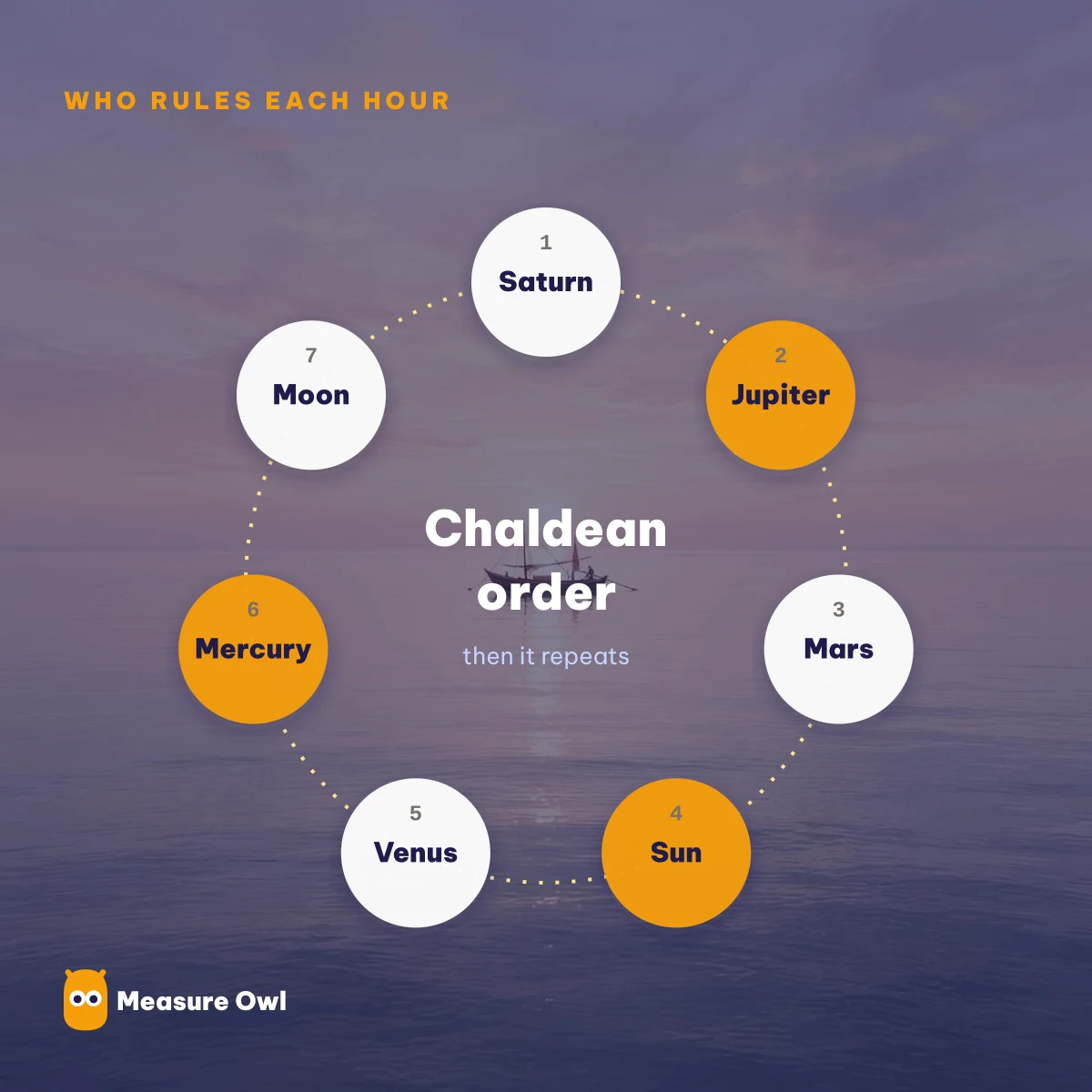
In the traditional system, the time from sunrise to sunset is split into twelve equal “day hours”, and the time from sunset to the next sunrise into twelve “night hours”. Each is ruled in turn by a planet in the Chaldean order, starting with the ruler of the weekday.
Why the hours are not 60 minutes
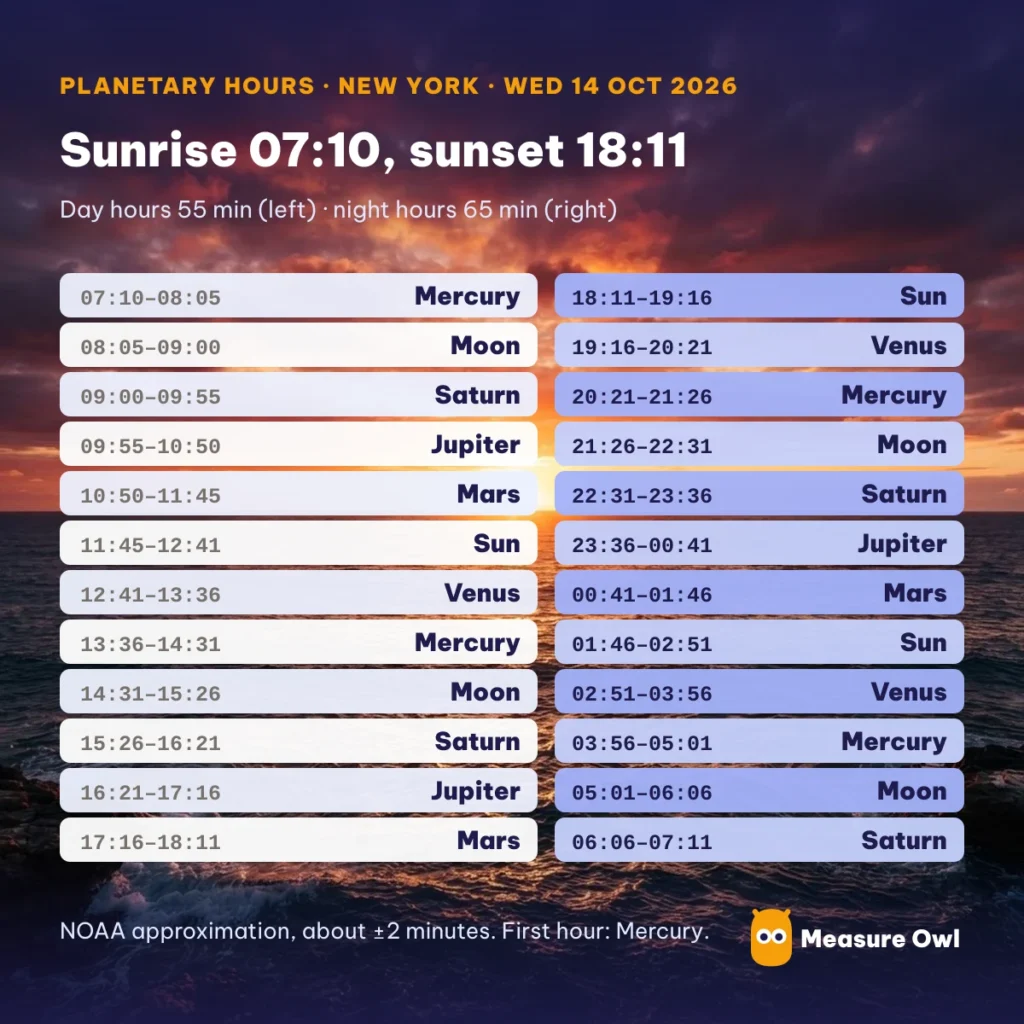
Because daylight changes through the year, a planetary hour is only 60 minutes at the equinoxes. On 14 October 2026 in New York, the Sun is up for about 11 hours 1 minute, so each day hour lasts about 55 minutes, while each night hour is about 65 minutes.
Worked example: Wednesday, New York
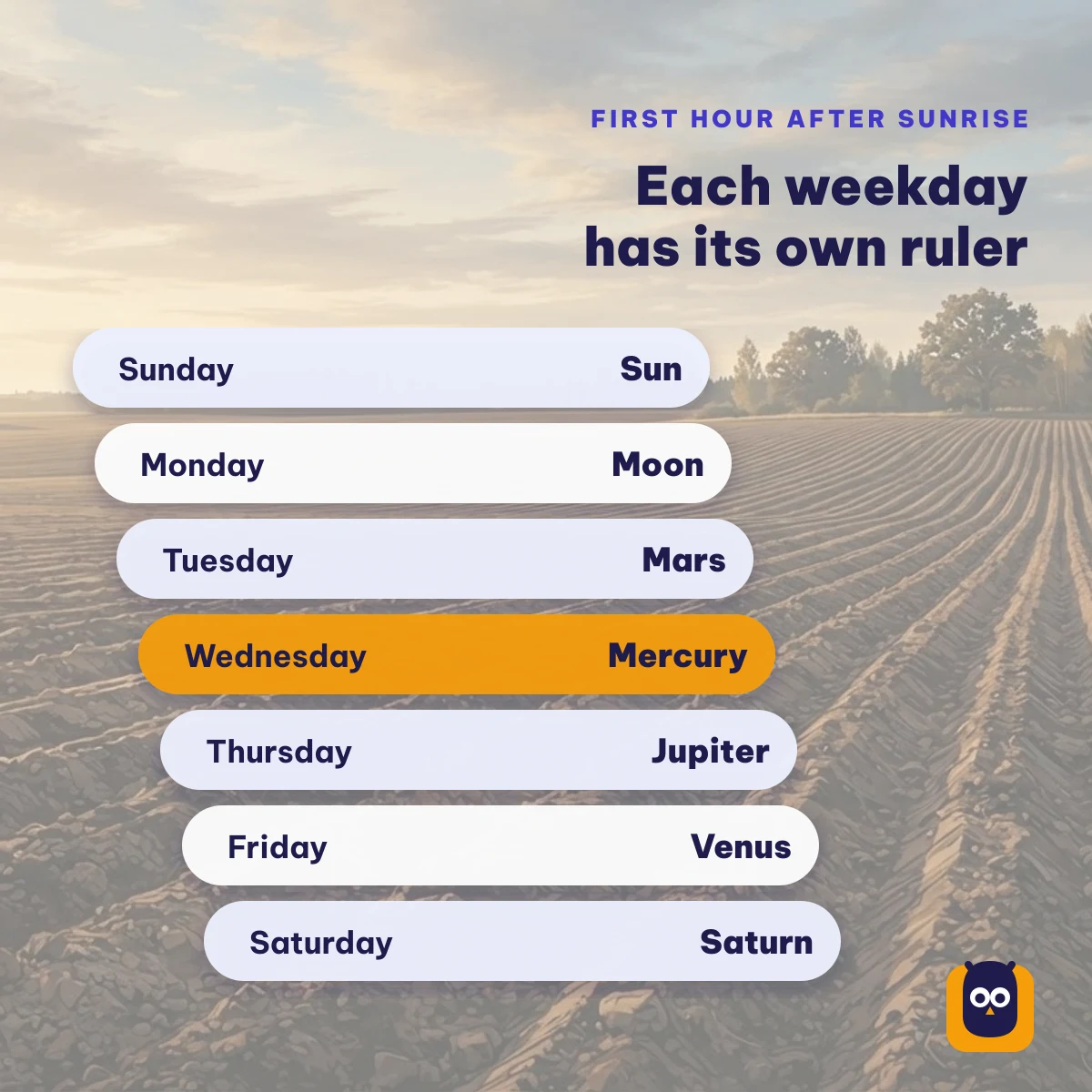
Wednesday belongs to Mercury, so the first hour after sunrise is Mercury. The next hours follow the Chaldean list: Moon, Saturn, Jupiter, Mars, Sun, Venus, then Mercury again. The calculator prints all 24 hours with start and end times so you can see exactly where each begins.
How the times are calculated
Sunrise and sunset come from the NOAA solar position approximation for the latitude and longitude you enter; the result is accurate to a couple of minutes in most places and is shown in your device’s time zone. If you prefer official values, enter your own sunrise and sunset and the hours are built from those. Near the poles, where the Sun may not rise or set, you must enter the times by hand.
This is a timekeeping tool for a traditional scheme. It does not predict events and the page makes no claims about astrological outcomes.
Frequently asked questions
What is a planetary hour?
One twelfth of the daylight or night period, assigned to a planet in a fixed repeating order.
Which planet rules the first hour of each day?
Sunday the Sun, Monday the Moon, Tuesday Mars, Wednesday Mercury, Thursday Jupiter, Friday Venus and Saturday Saturn.
Why do the hours differ in summer and winter?
Because day length changes. In summer day hours are longer than night hours; in winter it is the other way round.
See also the Unit Converter for other time and unit tools.
Did the owl get it right?
Mark this page useful, or tell us what to improve.
Thank you. Your note has been received.