Hours To Days Calculator
An hours to days calculator divides hours by 24 to give days, so 1,000 hours is 41 days 16 hours, or 41.67 days. It also shows the same span in weeks, and turns days back into hours. Enter any number of hours to see days, hours and minutes.
41 days 16 h 0 min
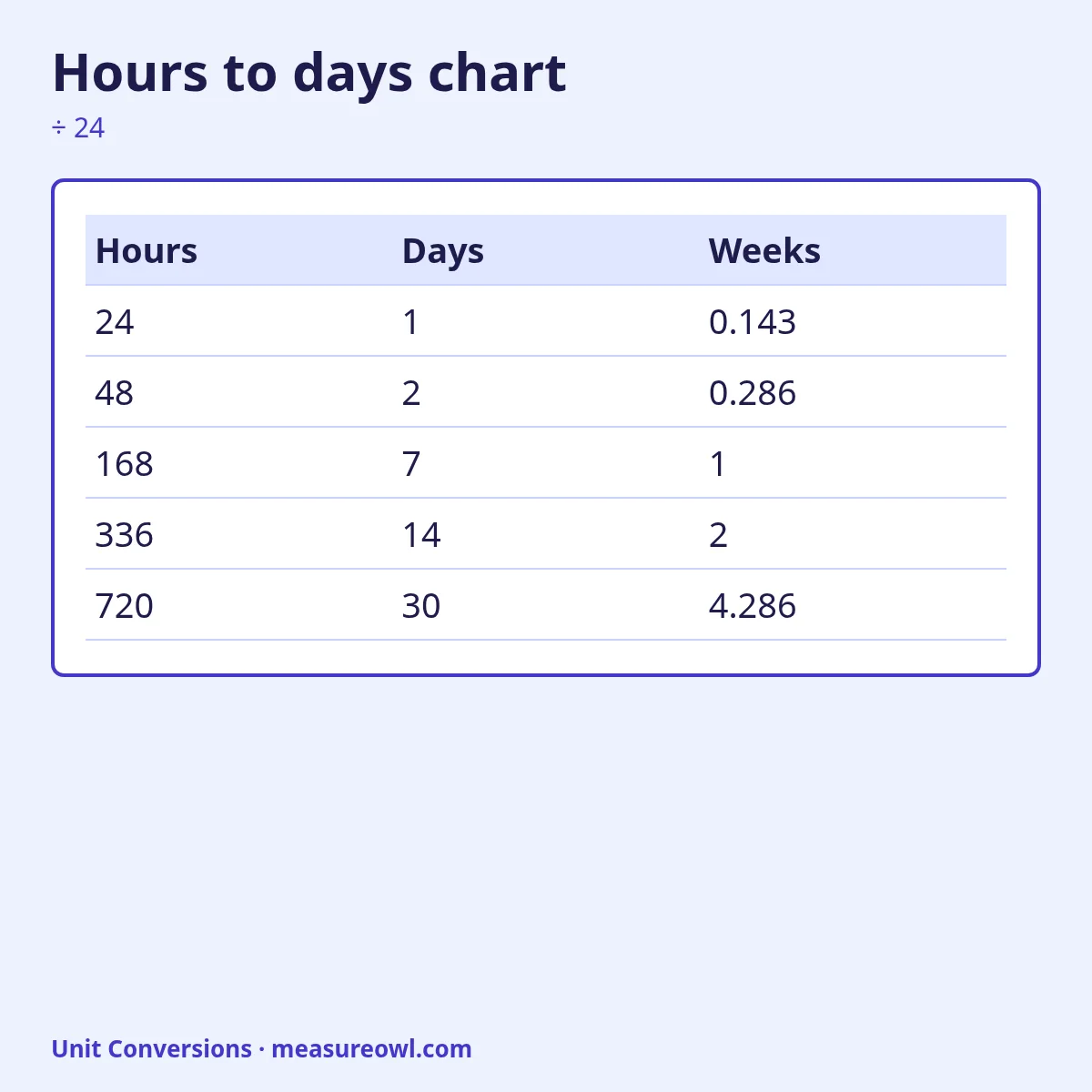
1000 hours = 41.6667 days = 5.952 weeks (1000 ÷ 24 and ÷ 168).
7 days = 168 hours (7 × 24)
Measure Owl Team · Updated
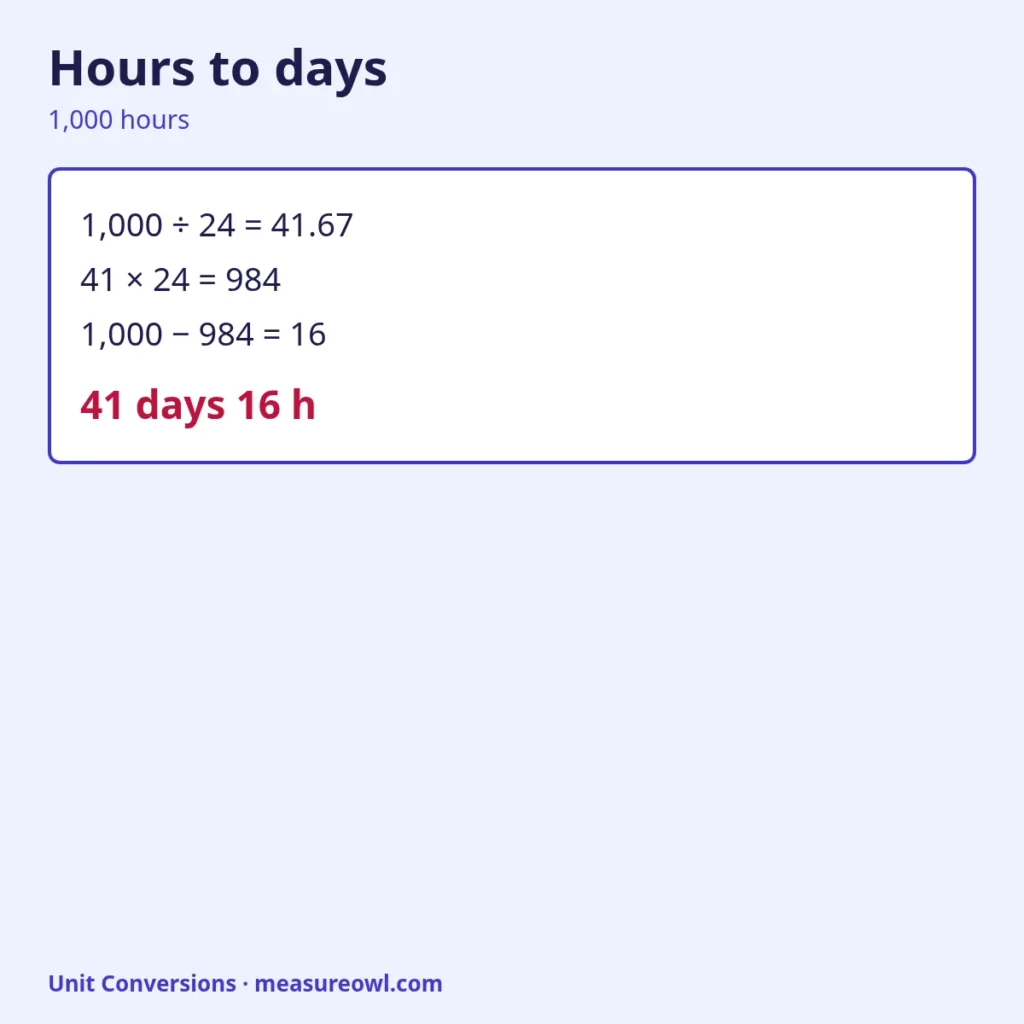
Worked example: 1,000 hours
1,000 ÷ 24 = 41.6667, so 41 whole days. The remainder is 1,000 − 41 × 24 = 1,000 − 984 = 16 hours, so 1,000 hours is 41 days 16 hours. In weeks it is 1,000 ÷ 168 = 5.95. For the reverse, 7 days × 24 = 168 hours.
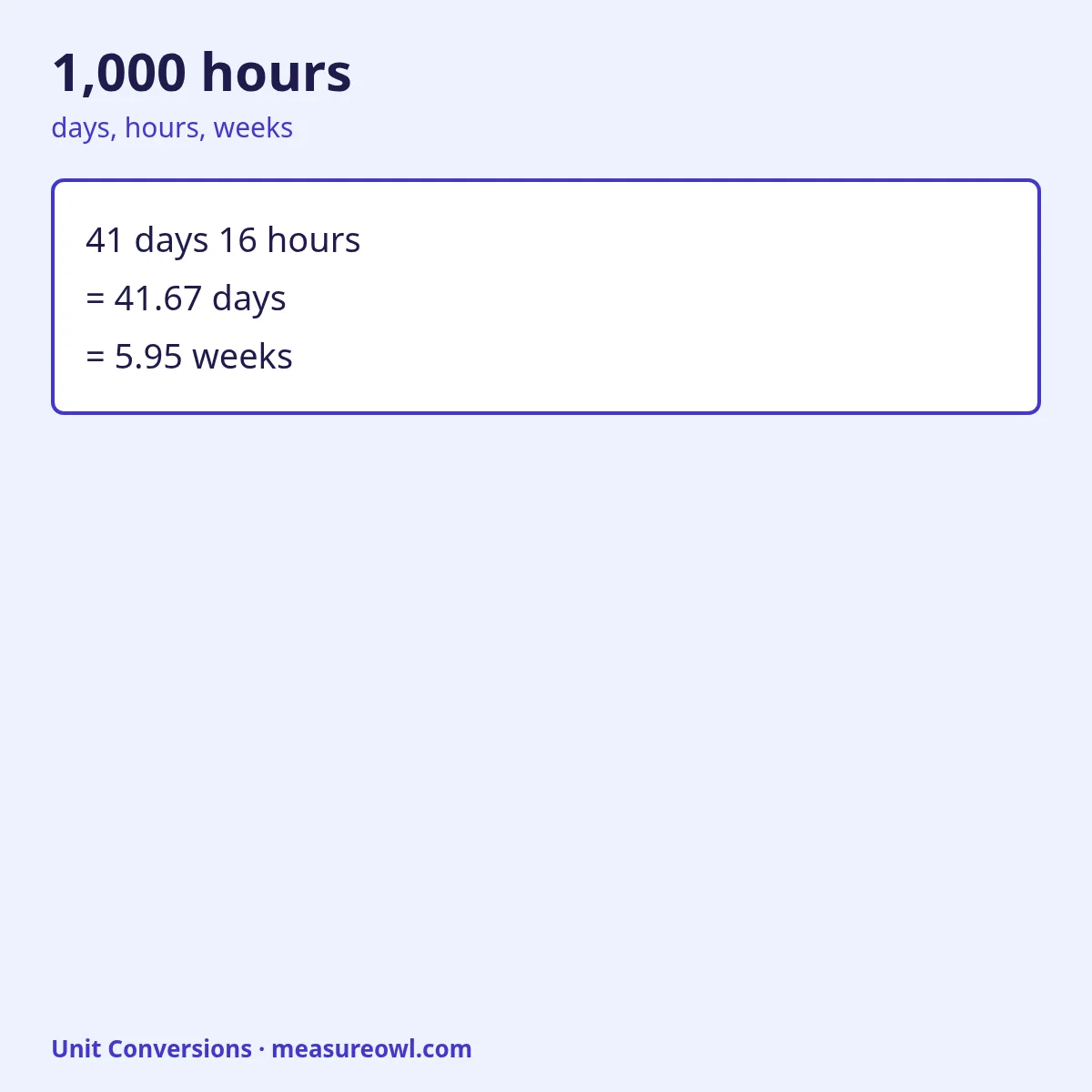
Hours to days chart
| Hours | Days | Days and hours | Weeks |
|---|---|---|---|
| 24 | 1 | 1 d 0 h | 0.143 |
| 48 | 2 | 2 d 0 h | 0.286 |
| 72 | 3 | 3 d 0 h | 0.429 |
| 96 | 4 | 4 d 0 h | 0.571 |
| 168 | 7 | 7 d 0 h | 1 |
| 336 | 14 | 14 d 0 h | 2 |
| 720 | 30 | 30 d 0 h | 4.286 |
| 1,000 | 41.6667 | 41 d 16 h | 5.952 |
| 8,760 | 365 | 365 d 0 h | 52.143 |
8,760 hours is a common year of 365 days. To turn power and time into energy, use the watt-hours calculator
Tips
- For a span between two dates, use the hours ago calculator, which follows the clock changes of your device.
- For hours and minutes together, enter decimal hours: 1.5 is 1 hour 30 minutes.
- Add several spans with the hours addition calculator.
How we checked it
On 22 October 2026 we compared the page’s arithmetic with a separate Python calculation on 250 random cases: no differences. We also confirmed that every row of the chart matches 24 hours per day.
Frequently asked questions
How do you convert hours to days?
Divide the hours by 24. 72 hours is 72 ÷ 24 = 3 days.
How many days is 1,000 hours?
41 days and 16 hours, which is 41.67 days or 5.95 weeks.
How many hours are in a week?
168, which is 7 × 24.
Does a day always have 24 hours?
A clock day has 24 hours, but a day with a daylight saving change has 23 or 25. This calculator counts 24 hours per day.
More tools are on the hours calculators page. Back to Unit Conversions.
Did the owl get it right?
Mark this page useful, or tell us what to improve.
Thank you. Your note has been received.