Kilowatt Hours Calculator
A kilowatt hours calculator turns power and time into energy: kilowatts × hours = kWh. A 1,500 W heater running 2 hours uses 3 kWh. Enter watts or volts and amps, set the hours and your price per kWh, and it shows energy per day, month and year, and the cost.
3 kWh a day · 90 kWh a month
1500 W = 1.5 kW; 1.5 kW × 2 h = 3 kWh a day; × 30 days = 90 kWh; × 365 days = 1,095 kWh a year. At 0.16 per kWh that costs 0.48 a day, 14.4 a month and 175.2 a year.
1.8 kW · 3.6 kWh in 2 h
120 V × 15 A × 1 = 1,800 W = 1.8 kW; 1.8 kW × 2 h = 3.6 kWh (single-phase AC).
5.56 kWh a day · 166.8 kWh a month
Watts are example values; use the label on your device. At 0.16 per kWh the month costs 26.69.
Measure Owl Team · Updated
Worked example: a 1,500 W space heater
1,500 W ÷ 1,000 = 1.5 kW. Running 2 hours a day, it uses 1.5 kW × 2 h = 3 kWh a day. Over 30 days that is 3 × 30 = 90 kWh, and over 365 days it is 3 × 365 = 1,095 kWh. With an example price of 0.16 per kWh, the day costs 3 × 0.16 = 0.48, the 30 days cost 14.40 and the year costs 175.20. Replace 0.16 with the rate on your own bill.

The formula in one line
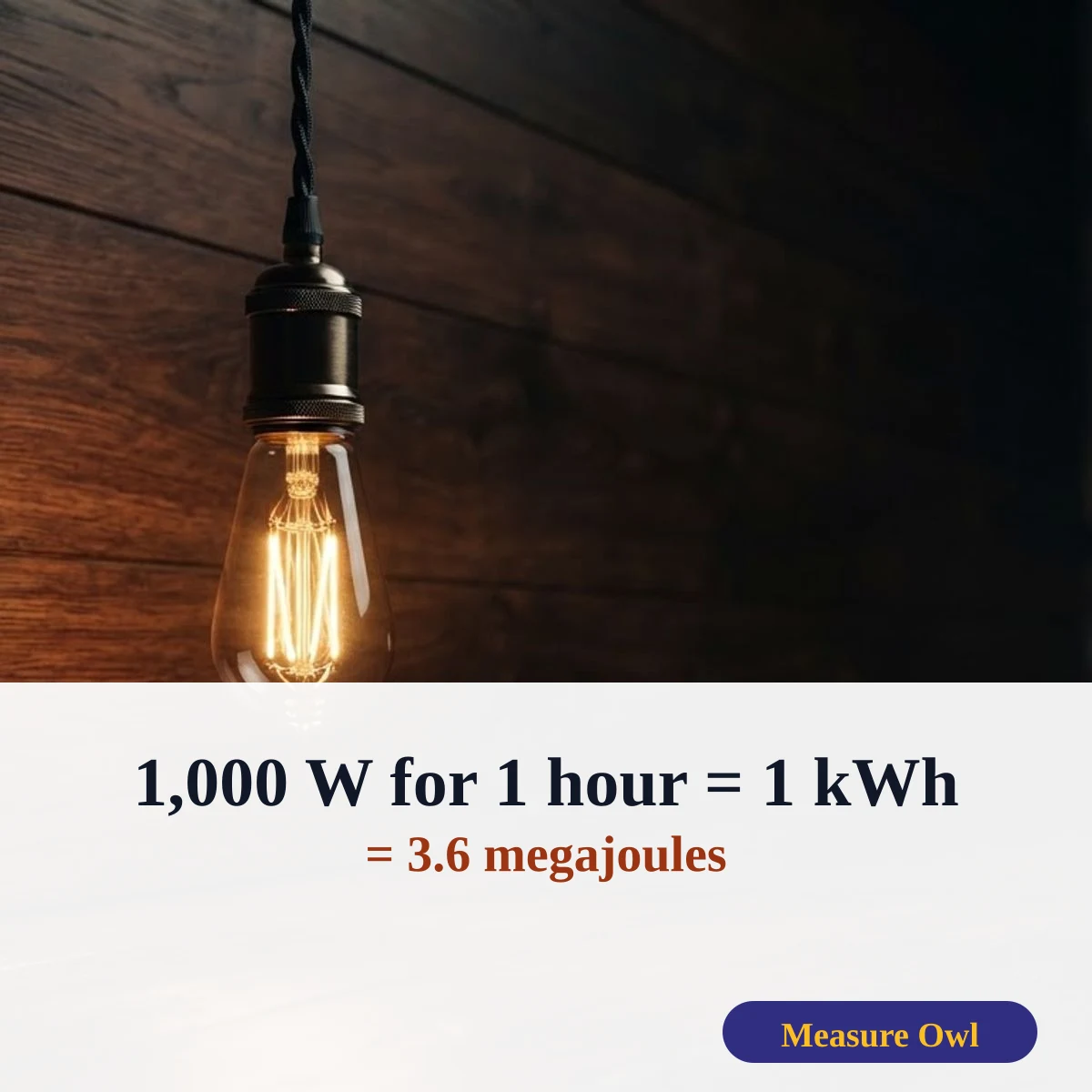
Energy in kWh = power in kW × time in hours. A kilowatt hour is the energy of 1,000 watts running for one hour, which equals 3.6 megajoules (3.6 × 10⁶ joules) under the SI conversion factors listed in NIST Special Publication 811 (2008 edition). For single-phase AC, power in watts is volts × amps × power factor; use a power factor of 1 for resistive loads such as heaters and kettles.
Typical device energy per use
The watts below are example values used in the multi-device box above; the label on your device is the figure to trust.
| Device (example) | Watts | Hours a day | kWh a day |
|---|---|---|---|
| LED bulb | 10 W | 5 | 0.05 |
| Laptop | 60 W | 6 | 0.36 |
| TV | 100 W | 4 | 0.40 |
| Microwave | 1,000 W | 0.25 | 0.25 |
| Space heater | 1,500 W | 3 | 4.50 |
Together they add up to 5.56 kWh a day, or 166.8 kWh over 30 days.
Unit conversions for energy: kWh, joules and BTU
These unit conversions let you compare a kilowatt hour with other energy units. 1 W = 1 joule per second, so 1 kWh = 1,000 W × 3,600 s = 3,600,000 J = 3.6 MJ. In heat units, 1 kWh is about 3,412 BTU (International Table), and 1 MWh is 1,000 kWh. Use the same steps in reverse: divide joules by 3,600,000 to get kWh.
How to work it out by hand
- From watts: divide by 1,000 for kW, then multiply by hours.
- From amps and volts: multiply volts × amps (× power factor) for watts, then follow the steps above.
- From minutes: divide minutes by 60 to get hours first. 45 minutes is 0.75 h, so a 1,000 W microwave for 45 minutes uses 0.75 kWh.
- Cost: multiply kWh by your price per kWh. Utility bills may add fixed charges that this does not include.
To turn the hours into days first, use the hours to days calculator; for more time tools see all the hours calculators.
Frequently asked questions
How do you calculate kilowatt hours?
Divide the watts by 1,000 to get kilowatts, then multiply by the hours of use. A 500 W device running 4 hours uses 0.5 kW × 4 h = 2 kWh.
How many kWh does a 1,500 watt heater use in a month?
At 2 hours a day for 30 days it uses 1.5 kW × 2 h × 30 = 90 kWh. Change the hours in the tool to match how long yours actually runs.
How do I convert amps and volts to kWh?
Multiply volts by amps (and by the power factor for motors) to get watts, divide by 1,000 for kW, then multiply by hours. 120 V × 15 A = 1,800 W = 1.8 kW, so 2 hours is 3.6 kWh.
What is the difference between kW and kWh?
A kilowatt (kW) is a rate of using energy, while a kilowatt hour (kWh) is the amount used over time. A 1 kW device running for 1 hour uses 1 kWh.
Did the owl get it right?
Mark this page useful, or tell us what to improve.
Thank you. Your note has been received.